Happiness, afflicted

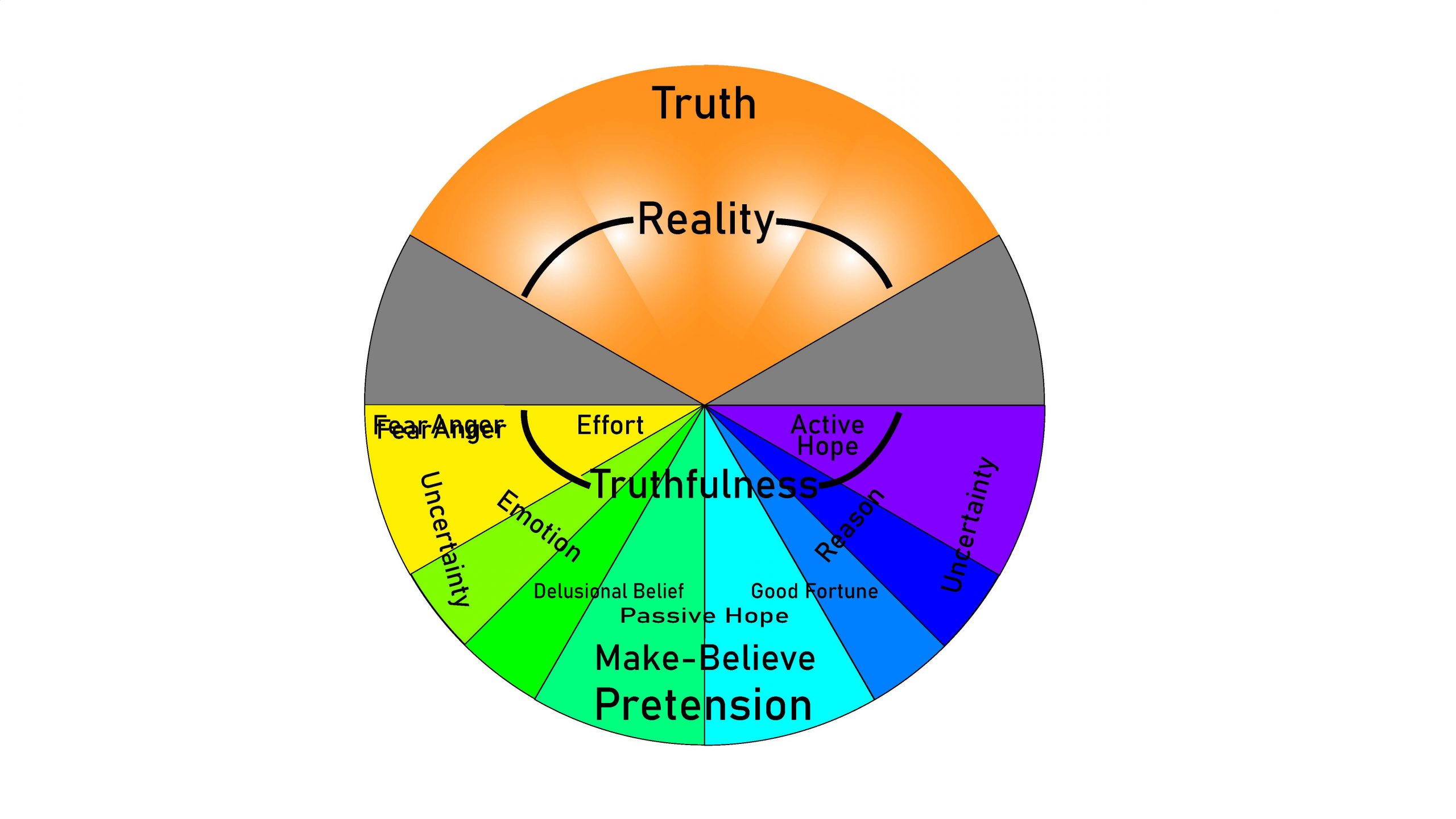
People look at me funny; sideways; trying not to make eye contact. People who care, (and those who pretend to care – I have a hard time telling the difference), express concern; they say they are worried about me. I believe they believe I am afflicted; troubled: distressed; cursed. I believe I am unafflicted; but yes – troubled and distressed. I believe we are all equally cursed …and blessed by our Humanity. I believe those who see my fear and anger and uncertainty, and express concern, are afflicted with good fortune and/or passive hope and/or delusional belief. Certainty is delusional belief. When I express my fear and anger and uncertainty, though I am seen as afflicted, I believe I am unafflicted; offloading the burden of pretension and make-believe. When I express my fear and anger and uncertainty, my truthfulness is closer to Reality; closer to Truth. I believe good fortune, passive hope, delusional belief distances one's truthfulness from Reality and Truth. I believe today, most of us prefer this distance most of the time. When I work to close the gap, people look at me funny. So I feel compelled to fall back on pretension and make-believe. I am going in circles; because it is circular. If Truth is at 12:00 and Reality ranges clockwise from 10:00 to 2:00, pretension and make-believe along with one’s truthfulness range counterclockwise from 9:00 to 3:00. I see pretension and make-believe strongest at 6:00. Reason labors between 6:00 and 3:00; emotion scampers between 6:00 and 9:00. I see my uncertainty grow stronger (clockwise) from 7:30 to 9:00 and (counterclockwise) from 4:30 to 3:00. One minute I see my fear at 8:59 and my anger at 9:00, the next minute my anger is at 8:59 and my fear is at 9:00. I see my active hope (i.e. effort) strongest at 3:00, driven at 9:00, and essentially nonexistent between 4:30 and 7:30. When I fall back on passive hope, delusional belief, good fortune, I am wandering, aimlessly, clockwise and counterclockwise, from 7:30 to 4:30. There are dead zones from 9:00 to 10:00 (clockwise) and from 3:00 to 2:00 (counterclockwise); buffers that lack any belief, emotion, effort, hope, pretension, make-believe, (good or bad) fortune, certainty or uncertainty, yet (I believe) these dead zones are closer to Reality and Truth than today allows. I believe to cross through a dead zone into Reality is dangerous; like flying too close to the Sun. Nonetheless, I am contemplating the journey.

Reality Wheel
Posted in Philosophy | Leave a comment

Happiness, radicalized

4.43 – 4.18 = 0.25. This week I am struggling. Is 4.18 close enough? Good enough? Is it okay to settle for 94.36%? When 100% is possible? Of course, now that the work is done at 94.36%, 100% means additional labor. So do we determine “good enough” based on the additional costs? Or is “good enough” never good enough? And do we even consider or address the fact that it could have been done at 100% in the same amount of time with the same effort as was put into the 94.36%? I understand diminishing returns, so perhaps the decision includes an analysis of the purpose and resulting actions from this number. If consequences are inconsequential and no harm comes to individuals in the making of this data, then perhaps ballpark is good enough. But if this is, say, an accountability measurement in which a lower number indicates a better performance, and let's say the overall average is 4.04, I would much rather be identified as a 4.18 than as a 4.43. 4.18 just seems so much closer to everyone else. Yet in this case, 4.18 is inaccurate.

I have always been labeled a perfectionist. And I have very high standards regarding fairness and justice. And these factors are very much a part of my struggling this week.

First, (and really as an aside), 4.04 is exceedingly high as an overall average. Let’s say 4.04 is the average number of requests communicated to obtain a required or desired service. If I had to go through a drive-thru on average 4.04 times to get my meal, I believe I would seek another establishment to patronize. On the other hand, in some government offices and/or other like-minded institutions (I’m thinking the Social Security office, the cable company, the bank…) in which condescending bureaucracy runs rampant, I might be thrilled with only 4.04 requests before fulfillment.

Second, should “good enough” (94.36%) ever be good enough? Especially when better or even perfect (100%) is attainable? And is this even more true with numbers and data that influence thoughts and actions? And if 100% accuracy is required, shouldn’t there be a system of checks for accuracy? And isn't that a supervisor's responsibility?

And third (and perhaps most important to the direction of this week's thought), how do I determine if the 94.36% is simply the limit of an individual's capability in the circumstance? Or laziness? Or apathy? Or even a malicious disregard? If it is a question of capability, then have we found potential for a learning/teaching moment from which to build on? If it is laziness or apathy, then again a teaching moment? Or perhaps a disciplinary action? And maybe an increase in accountability measures? Especially when it is an accountability measure inaccurately reported? If it is malicious disregard, then definitely discipline; right? And perhaps the beginning (or even the end) of the end. Or, (here is a radical thought), in this circumstance should I even consider individual responsibility? Or would it be best to allow the individual their individuality, perhaps make them aware of their mistake, then maybe let them choose if they would like a learning moment or if they would maybe rather just avoid tasks involving data? It does seem radical for a supervisor to allow their subordinate to choose their work, but when and where we can, why not? Productivity is enhanced by individual capability which is further enhanced by individual attraction to and curiosity about a task or a grouping of tasks. So, it only makes sense to (when possible) allow individuals to choose rather than to haphazardly assign tasks; especially in a setting in which versatility is expected and there are multiple tasks to assign. A misplaced or inconsiderate assignment may be resented which in turn could lead to laziness, apathy or even malicious disregard. And that brings us back to the difficulty of determining individual responsibility, now complicated by the knowledge that perhaps (because the supervisor did not bother to pre-assess interest and capability, nor did they check for accuracy) the supervisor is also (and perhaps as or more) responsible for the 94.36% when 100% was attainable.

I believe good enough is never good enough. I believe a supervisor can (to a point) assess output/results but no one except the individual can fairly assess the individual's effort and/or intent; especially when the expectation is versatility and the individual has not been trained for the specific task. I believe we should no longer, in good conscious, describe anyone as a subordinate. I believe we should no longer, in good conscious, treat anyone as a subordinate. Regardless of my beliefs, this is not, typically, how the workplace works. Nor do I believe this is typically how the human mind processes a task at hand. I obsess and work for perfection. I believe that in the (paycheck-to-paycheck) workplace, a majority of individuals accomplish a task to move on to the next task, believing quick is synonymous with efficient, never thinking outside the box, less concerned with accuracy than with output, and unconcerned with process improvement.

Responsibility: Obligation? Burden? Taken on? Assigned? Appreciated? Tolerated? Nurtured? Neglected?

To be assigned responsibility is a burden, tolerated and neglected.

To take on responsibility is an obligation, appreciated and nurtured.

Perhaps my point this week is that it should not be about accountability or learning moments or disciplinary action or separation. Perhaps my point this week is that it should be about awareness; a 360 degree, mutually beneficial, non-judgmental exchange of information to increase productivity, efficiency and accuracy. I do not believe accountability is a thing without awareness.

The opposite of aware is ignorant. The opposite of accountable is blameless. It is logical that if awareness must precede accountability, then ignorance (regardless of whose initiative is lacking) rejects appreciated-nurtured responsibility leaving only the tolerated-neglected-burden path of assigned responsibility that (by definition), because it does not include awareness, cannot include accountability.

Whether an individual chooses to be ignorant, or a power (i.e. supervisor, organization, government…) chooses to ignore (be ignorant of) ignorance, the result is the same. Simply put, to hold someone accountable for an assigned responsibility is oppression. To improve process and enhance productivity, efficiency and accuracy, those in power must allow individuals, whenever possible, to choose their work. And if/when this is not possible, those in power must be aware that an individual is unhappy with an assignment so they (the power) may empathize and react accordingly. And if this is a frequent or majority occurrence that (due to job requirements) will not change, the individual must be aware of this fact so they have an opportunity to adjust (either their interest / curiosity / capability or the circumstance) before a power feels they must make that adjustment for them; because at that point it will be a forced change of circumstance. A back and forth must occur; 360 degree awareness. It is a lot of work. Much easier for the power to simply bypass awareness, apply their take on accountability and not worry about that whole communicating and empathy thing.

Simply put, to hold someone accountable for an assigned responsibility is oppression. To improve process and enhance productivity, efficiency and accuracy, those in power must allow individuals, whenever possible, to choose their work.

Radical.

Posted in Philosophy | Leave a comment

Happiness: a damn lie

To say “you can do what you want” or “you can be what you want” is a lie; a lie that resulted in Trump and Hillary. On the one side, an uprising, a backlash, a revolt, a movement. On the other side, elitist, imperialist, condescending thoughts, words and actions.

Put this way, an uprising should have been expected. Except that not one of the national politicians (in either party) from Reagan forward recognized their rhetoric for what it was; until Trump. And perhaps that gives Trump too much credit. But regardless, he was somehow able to take advantage of this political blind spot by (instead of championing opportunity and hard work as all the others have done) focusing on winners and losers. It struck a chord.

As an individual Donald Trump does not represent, argue nor does he appeal to facts or reason; Donald Trump represents, argues and appeals to emotion and dissatisfaction. And he finds this anger and discontent very close to the surface in those constituents pissed off at Hillary Clinton for putting them in her “Basket of Deplorables.”

As an individual Hillary Clinton very much represents elitist, imperialist, condescending thoughts, words and actions. What I heard in her presidential campaign, directed at more than fifty percent of us, is “You have failed! Your hard work doesn’t matter! But if you vote for me, I’ll throw you a bone.”

So what? Why am I going on about Hillary and Donald? They are part of history now; right? Maybe. Maybe not. But what they represent, (as shown by the more than 74 million Trump votes in 2020), is very much alive and well and politicians are lining up to take advantage of this division.

Perhaps more insidious than Donald Trump appealing to emotion is his parallel appeal to an emotionless old guard working to maintain (and perpetuate) status quo. By inciting emotions, and continuously stirring the pot, fact and reason (and thereby progress or even much change) are stunted and/or nonexistent. This playbook will be copied. Trump was merely right place, right time. There will be others. There are others; jockeying for position.

Though I despise the pretentious hubris of center-left politics and I very much understand the anger and discontent of the working poor vocally represented in the center-right and right, I voted for Hillary in 2016 and Biden in 2020. I chose the possibility of reason, the possibility of bridging wealth and power gaps, the possibility of baby steps, over the division of emotion.

But I know the emotion is still there. I feel it in me; and all around me. And those center-left politicians who ignore it, who believe that with the election of Joe Biden we have put that Trump Monster to bed, do so at their own peril; and even more so at mine.

Forty-some years ago, when we first began hearing from our elected leadership that “you can do what you want” and “you can be what you want” I believe it was spoken as a hope; as a possibility. From there it evolved into a fact, transformed into a lie, became a damn lie, then mutated into Hillary Clinton. Donald Trump (or his handlers) came along and saw the hope that was fact that was lie and worked the same magic (on a shorter timeline) with anger and dissatisfaction to create a platform of lies to hinder progress and (even worse) to circumvent reason. The center-left platform is based on a lie that the center-left politicians believe is a fact, and (accepting the lie that “you can be what you want”), are able to reason from there. The center-right-right and right politicians simply lie, (which in a sense is more honest), and don’t even bother with reason, (which is again more honest).

And this is why we are pissed at Hillary; she is oblivious. With the republicans, we at least know that at least some of them know we’re being played and we know we’re being played. It’s an understanding that appears mutually beneficial. But many of today’s democrats actually believe the crockaganda they are feeding us.

So, if it is not the democrats and if it is not the republicans, then what is the answer?

According to American economist Frank Knight, in a paper published in 1923,

“We cannot accept want-satisfaction as a final criterion of value because we do not in fact regard our wants as final; instead of resting in the view that there is no disputing about tastes, we dispute about them more than anything else; our most difficult problem in valuation is the evaluation of our wants themselves and our most troublesome want is the desire for wants of the "right" kind.”

So what are wants of the ‘right’ kind?

Perhaps the answer will be found in ethical leadership who will recognize the disconnect between 1) a capitalistic generation of superficial wants and the resulting superficial valuation of tastes, merit and morality, and 2) the civic / social and moral generation of wants and desires that will restore dignity, educate, and encourage thoughtful effort, collaboration, compassion and long term survival.

Perhaps it is the market value engine that is the problem. Perhaps if we replace that market value engine with one of civic / social and moral value, our output will become cleaner, more productive and more efficient, generating wants of the ‘right’ kind.

But in this moment, we have the democrats, and we have the republicans.

Posted in Philosophy | Leave a comment

Plump Clumpy Happiness

I make a thick bean soup and I make red beans and rice. Typically, I use a canned creamed red bean from the south to attain the desired consistency for my red beans and rice, but I have previously experimented with dry beans for a fresher, cleaner flavor. This week I realized that my thick bean soup (using dry pinto beans) is the consistency I want for my red beans and rice. So I melded the two recipes together, (also borrowing from one or two others), to create the desired consistency and flavor, and at the same time come away with two distinctive dishes. I also realized as I was cooking that this method of writing the recipe and prepping, flavoring, mixing and cooking the food was similar to how our nation is governed. There are some underlying commonalities in the base foods and spices but by varying techniques, additions and flavors the result is two recognizably different dishes. Both outcomes utilize the ingredients and instructions in white. To make Thick Bean Soup follow the recipe in white and blue; ignore the red. To make Red Beans and Rice follow the recipe in white and red; ignore the blue. Below the actual recipe, I have rewritten it as it appears (to me) to apply to our elected representatives in Washington. Ingredients and instructions are changed according to my interpretation of politicians (in white), republicans (in red) and democrats (in blue). Proportions remain the same in both versions.

Thick Bean Soup or Red Beans and Rice:

  1. ½ lb. dry pinto beans, soaked overnight.
  2. 1 lb. dry red kidney beans, soaked overnight.
  3. Olive oil.
  4. 1 cup onion, diced.
  5. 3 stalks celery, diced.
  6. 2 cups vegetable broth + 3 cups water.
  7. 3 cups vegetable broth + 6 cups water.
  8. 1 can pinto beans, rinsed, drained and mashed.
  9. 2 (large) medium russet potatoes, diced.
  10. ¾ tsp garlic powder.
  11. ½ tsp oregano.
  12. ½ tsp thyme.
  13. ½ tsp cayenne pepper.
  14. ½ tsp cumin.
  15. ¾ tsp smoked paprika.
  16. 1 ½ tsp sea salt.
  17. ¼ tsp black pepper.
Sauté onion and celery in olive oil. Add liquid and dry soaked (rinsed) beans. Add spices. Simmer for 10 minutes. Separate contents into two pots; one (with more liquid) for the red beans, and one for the pinto beans. Add respective (rinsed) beans to their pots. Bring to a boil. Reduce heat and simmer for 1 – 3 hours. Add potatoes. Simmer until potatoes are almost done. Add mashed beans to desired heat and consistency. Remove from heat. Pull approximately one-half of liquid from pinto bean pot and add it to red bean pot. Using immersible blender, puree pinto bean pot contents. Using slotted spoon, add red bean pot contents to pinto bean pot. Add red bean pot broth as necessary for desired consistency; (thick but still pourable). Let cool, then set aside and/or refrigerate while preparing the rice below.
  • 1 cup dry rice.
  • 3 cups water.
Parboil rice in water above, then drain and Rinse and finish rice prep in 9 x 13 casserole dish as directed below.
  • ½ stick butter.
  • 2 cups water.
  • ¾ cup vegetable broth.
  • Parboiled rice.
  • 6 to 8 cups bean mix from above.

Plop red beans on top of liquid, covering the top; beans may settle into liquid. Do not stir; gently smooth with spoon or spatula if necessary. Cover and bake at 375 for 40-60 minutes or until liquid is absorbed by rice. Note: As a leftover you will find the beans likely drier and somewhat clumpy, though the rice should have maintained integrity and plumpness. It is recommended to add an appropriate amount of vegetable broth to restore desired consistency before reheating.

Densely Blended Soup Pot or Red Blooded Americans and Rich White Men:

  1. ½ lb. dry consumers, soaked overnight.
  2. 1 lb. dry red-blooded American consumers / constituents, soaked overnight.
  3. Rhetoric.
  4. 1 cup indignity, diced and widely distributed.
  5. 3 stalks humiliation, diced and widely distributed.
  6. 2 cups Market Value + 3 cups Capitalism.
  7. 3 cups Market Value + 6 cups Capitalism.
  8. 1 can consumers, rinsed, educated and indoctrinated.
  9. 2 (large) medium gaps (wealth and power), widened, diced and largely ignored.
  10. ¾ tsp welfare state.
  11. ½ tsp credentialism.
  12. ½ tsp nationalism.
  13. ½ tsp fundamentalism.
  14. ½ tsp distributive justice.
  15. ¾ tsp explicit bias.
  16. 1 ½ tsp implicit bias.
  17. ¼ tsp opportunity and mobility.
Sauté indignity and humiliation in rhetoric to enhance palatability. Add Capitalism and Market Value and soaked consumers. Add spices (10 thru 17) for flavor according to your recipe. Simmer for effect. Segregate contents into two pots; one (with more Market Value and Capitalism) for the red-blooded Americans, and one for the remaining consumers. Add respective (rinsed) consumers to their pots. Bring to a boil. Reduce heat and simmer for 4 – 6 years. Add wealth and power gaps. Simmer until gaps are absorbed and accepted. Before adding educated, indoctrinated consumers, mash with bureaucracy. Once mashed, add educated, indoctrinated consumers to attain desired heat and consistency. Remove from heat. Pull approximately one-half of Capitalism and Market Value from standard consumer pot and add it to the American consumer pot. Using immersible bureaucracy, puree standard consumer pot contents. Using slotted spoon, add American consumer pot contents to standard consumer pot. Add American consumer pot Capitalism and Market Value as necessary for desired consistency; (thick but still pourable). Let cool, then chill while reinforcing existing wealth and power gaps with the ingredients and methods below.
  • 1 cup long grain enriched super fancy white men from the wealthy side of the gap.
  • 3 cups Capitalism.
Plump, Praise, and Shower enriched white men above in Capitalism to ensure individual integrity and separation from consumers, then finish recipe as instructed below.
  • ½ stick racism.
  • 2 cups Capitalism.
  • ¾ cup Market Value.
  • Plumped enriched white men.
  • 6 to 8 cups consumer mix from above.

Plop consumer mix on top of Capitalism and Market Value. Depending on the consistency and degree of bureaucracy some consumers may settle down into the Capitalism and Market Value surrounding the wealthy. This is okay but do not mix or stir; gently smooth the top with spoon or spatula if necessary for amenability. Cover and bake at 375 for an additional 4 – 6 years or until all the Capitalism and Market Value is absorbed by the enriched white men. Note: As time goes by you will find the consumers have likely become drier and somewhat clumpy, though the rice should have maintained integrity and plumpness. It is recommended to add an appropriate amount of Market Value before reheating to restore desired consistency and maintain status quo.

And there you have it.

Posted in Philosophy | Leave a comment

A Long Way From Happiness

Salvation or, (if you prefer), meaning / purpose through the Ages has undergone multiple facelifts.

From:

  1. The Catholic Church – Salvation through religious observance and good works, to
  2. The Protestant Reformation – Salvation through Grace alone, to
  3. Calvinism – Strenuous work and asceticism as a sign of salvation, to
  4. The Protestant Work Ethic – Salvation earned through strenuous work, to
  5. Capitalism – Capital accumulated through asceticism, to
  6. An Entrenched Opportunity Gap – Capital and worldly success as a sign of salvation, to
  7. An Entrenched Wealth Gap – Wealth and power as the source of salvation.

In #1 above it feels like “religious observance” and “good works” are synonymous, or at least go hand-in-hand, implying that good works is an underpinning of faithful adherence and faithful adherence works to shelter and protect good works.

Grace alone implies a complex design of predestination in which everyone is equally base and no one is deserving.

According to Calvinist thought, a sign of salvation is merely that, a sign, and does not discount or dispose of Grace.

It is the Protestant Work Ethic that transformed a sign of Salvation into a source of Salvation and put redemption in the hands of the individual.

Capitalism may seem an intermediate step, but it is the most decisive step away from Church as State and toward State as Church.

Once capital is accumulated, lines are drawn.

Today wealth and power no longer needs to be earned. Good fortune such as inheritance or right-place-right-time serves hubris as readily as strenuous work and asceticism and is too often mistaken for Grace.

Good fortune is not Grace in that good fortune not only allows but often also feeds hubris whereas Grace insists on a respectful, unpretentious, humble compassion for All.

I have recently considered some results of this evolution (here – Shedding Happiness, here – A Monopoly on Happiness, here – Candy-Coated Happiness, and here – Throttling Happiness). This week I am intrigued by our progression from a religious perspective to a more secular stance, from Salvation to Meaning / Purpose, and how or if this parallel to our political progression through the Ages has influenced thought. Looking at a snapshot from today, some claim that the lessening and/or absence of religious influence has resulted in the disappearance of civic and moral value, yet politically it is today's right who largely make that claim and it is today's right working harder to maintain the status quo of wealth and power; and it is today's left working to move us toward a greater appreciation of civic virtue. Contradiction and division. So do we need another Protestant Reformation? Because today it feels like the political left is more equitably operating under the influence of Luther and Calvin, (Salvation or Meaning / Purpose through Grace alone), and the political right has completely eliminated Grace and fully incorporated the secularism of wealth and power into their religious rhetoric on salvation. Just like the Calvinists before them, the political right has turned religion upside down to fit their agenda, only the result today, (An Entrenched Opportunity Gap and An Entrenched Wealth Gap), in the context of such rapid technological change and nearly 8 billion people, is far more insidious.

If religion has become rhetorical, it is hard to say it has had much influence. But, after the Protestant Reformation, if we would have veered toward Grace and even a worldly version of predestination (i.e. randomness and chance loom and influence large) instead of coming to believe we had the power to control our own destiny, perhaps religion would/should have had a greater impact. It feels ironic that (according to consensus definition), politically religion has become secularism and secularism has become religion.

Think about that! Religion advances the secular goals of wealth and power, and secularism advances the religious goals of equitable empathy and compassion. It appears to me that Martin Luther championed Grace and felt that all were equally (un)deserving, yet despite Luther's best efforts, the Protestant Reformation merely created a form of Catholicism with less ritual dogma. As I said, this is how it appears to me within my limited research and knowledge; please educate me if my impression is mistaken.

So, if, (since the Protestant Reformation or perhaps even since the dawn of civilization), religion has been politicized, and if religion (in actuality) is merely a vehicle for power and control, then does this place God and Salvation outside the purview of Protestant denominational religion? And have these things always been outside the purview of Protestant denominational religion? Or is this banishment more recent brought about by the (seemingly more) forceful and rapid changes of the last 40 years? I believe it could be argued either way. I could make a case that we threw the baby (God) out with the bathwater (Grace) hundreds of years ago, but I can also see how one might have still felt God's presence in the midst of strenuous work and asceticism. But in the last 40 years it feels like power (and politics) has become so far removed from strenuous work and asceticism that (as I previously said) religion has become Godless and secularism has become our only path to Grace.

I believe if we would have held on to some semblance of Grace, religion (and perhaps politics) would not be nearly so divisive, and because I believe organized denominational religion would have evolved much differently under the auspices of Grace than (as it has been for several hundred years) dominated by individual worthiness, perhaps my efforts this week, (instead of determining how or if religious thought has influenced political thought), have determined the driving force to be neither religion nor politics, but Grace; or its lack.

A lack of Grace is a pursuit of intemperate power. If Grace insists on a respectful, unpretentious, humble compassion for All, then a lack of Grace insists on an inconsiderate, pretentious, selfish disregard for all and everything beyond this moment. If intemperate power is at mile marker 1 and Grace is at mile marker 100, today's politicians would be on a roundabout going in circles between mile markers 3 and 5.

Grace. We have a long way to go.

Posted in Philosophy | Leave a comment